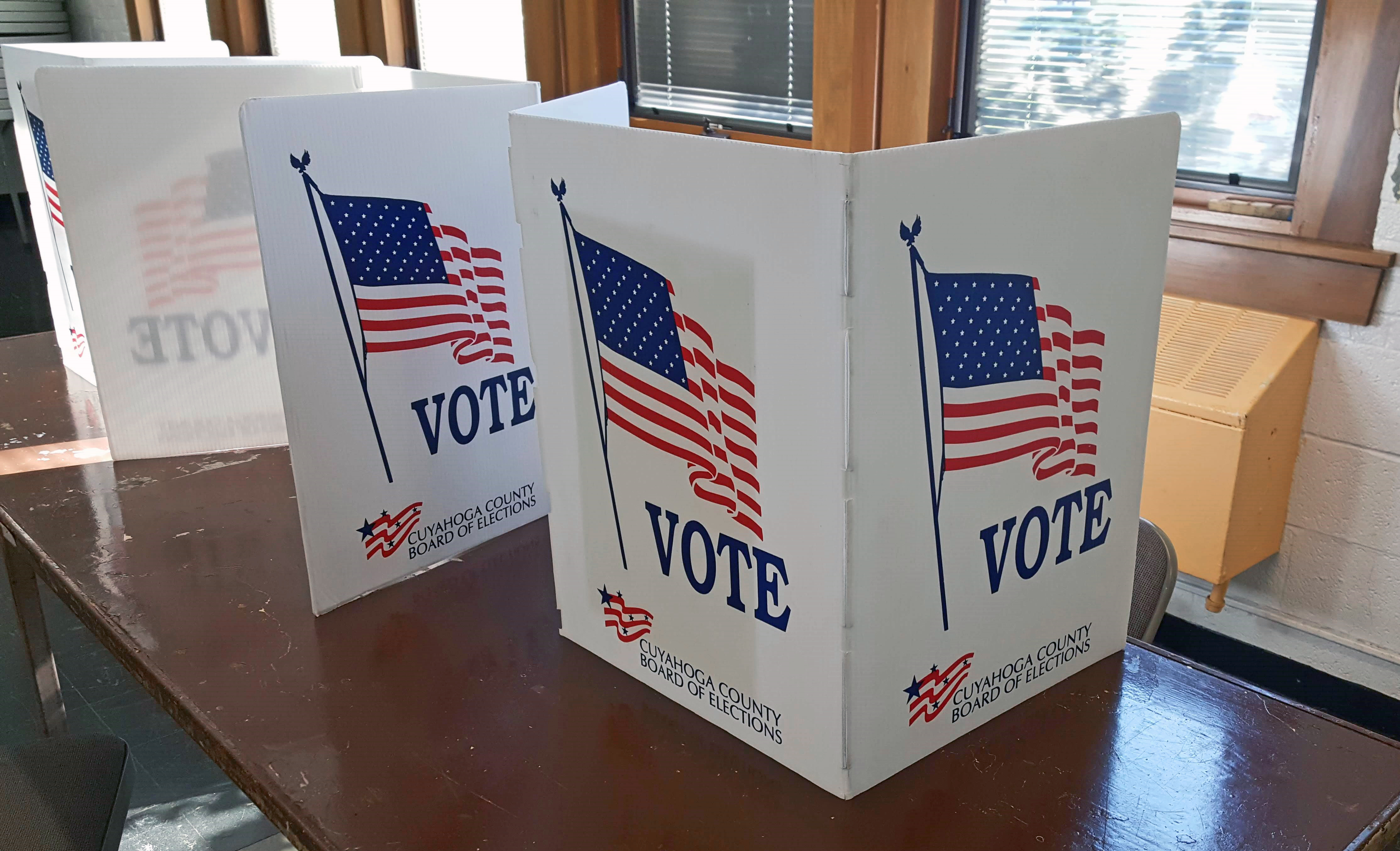
Franklin County voters cast 511,532 ballots in the Nov. 3 general election.
Democratic candidates dominated Franklin County’s unofficial results posted by the Franklin County Board of Elections. All 889 precincts reported results, though the tallies remain unofficial.
As we reported Nov. 3, Amy Acton won the governor's race statewide by a 51/46 margin over Republican Vivek Ramaswamy. In Franklin County, Acton's margin was far wider: 363,745 votes (71.77%) to Ramaswamy's 131,513 (25.95%). Acton is the first woman and first Jewish person elected governor of Ohio, according to Columbus Underground. She replaces Governor Mike DeWine, who was term-limited.
Sherrod Brown's U.S. Senate win, which we also covered Nov. 3, showed a similar Franklin County split. Brown collected 349,983 votes (69.20%) to Republican Jon Husted's 136,999 (27.09%).
In U.S. House races, Democrat Joyce Beatty held Ohio's 3rd District with 77.22% in Franklin County. Democrat Don Leonard flipped the 15th District, taking 62.19% of the Franklin County vote to Republican Mike Carey's 35.18%. Columbus Underground reported that the 15th District covers the south and western portions of Franklin County and stretches into rural areas near Springfield and Dayton.
Democrats also dominated the four statewide down-ballot offices within Franklin County. John Kulewicz led Keith Faber for attorney general with 69.94%. Annette Blackwell led Frank LaRose for auditor of state with 68.34%. Allison Russo led Robert Sprague for secretary of state with 70.11%. Seth Walsh led Jay Edwards for treasurer of state with 69.78%. Columbus Underground reported that statewide, those four races remained too close to call as of midnight on election night with 87% of precincts reporting.
Early voting doubled
In-person early voting nearly doubled. Franklin County in-person early voting was up 87% over the 2022 midterm, Columbus Underground reported, citing the Ohio Capital Journal. Board of Elections Director Antone White told WBNS before Election Day that the county was "seeing about two times the amount of voters we saw in the last midterm election in 2022."
Of the 511,532 total ballots, 342,614 were cast on Election Day, 93,158 were in-office absentee ballots and 75,760 were mail-in absentee ballots, according to the Board of Elections results. The county has roughly 906,091 registered voters.
Columbus restructures City Council
Columbus voters approved two charter amendments that will reshape how the city elects its council members. Issue 8, brought by the grassroots coalition Our City, Our Say, passed with about 82% support, according to the Columbus Dispatch. Issue 9, placed on the ballot by City Council, passed with about 57%.
Together, the amendments establish nine district-only seats and four at-large seats, bringing the total to 13 members. The at-large seats will be phased in: two added in 2028 and two more in 2030, each serving four-year terms, Columbus Underground reported.
Columbus will hold district-only council elections beginning in 2027 for the first time in over a century, the Dispatch reported. The city had been the most populous in the country with no district-only representation on its council.
Will Petrik with Our City, Our Say, the organization that placed Issue 8 on the ballot, said in a statement that the coalition was grateful for the voters and organizations that supported the measure. Council President Pro Tempore Rob Dorans, who championed Issue 9, said in a statement that the community should not be afraid of evolving its systems of governance, the Dispatch reported.
The next Columbus council elections are in 2027.